
Rule of thumb, and the exceptions
A properly balanced garage door will stay exactly where you leave it, with the opener disconnected, at any point along its track. That's the whole test. The exceptions: a door with moderately worn springs may hold for a few seconds and then drift down slowly, which still counts as a fail, just a quieter one. A door with a bent track or a warped section (common in older Philadelphia rowhomes with original wood or early steel doors) may bind and refuse to move smoothly even when the springs themselves are fine, which muddies the test. And if a torsion spring is visibly broken — a gap in the coil, a door that won't budge at all — skip the test entirely and call a technician, because that door has no business being lifted by hand.
Tools you need
- Work gloves
- A flashlight
- A phone to time how long the door holds its position, and to film it if something looks off
- A second person, if you can get one, to spot the door while you watch the springs and cables
Step-by-step: testing the balance
- Close the door completely. You want a clean starting point, and the springs are under the most predictable tension when the door is fully down.
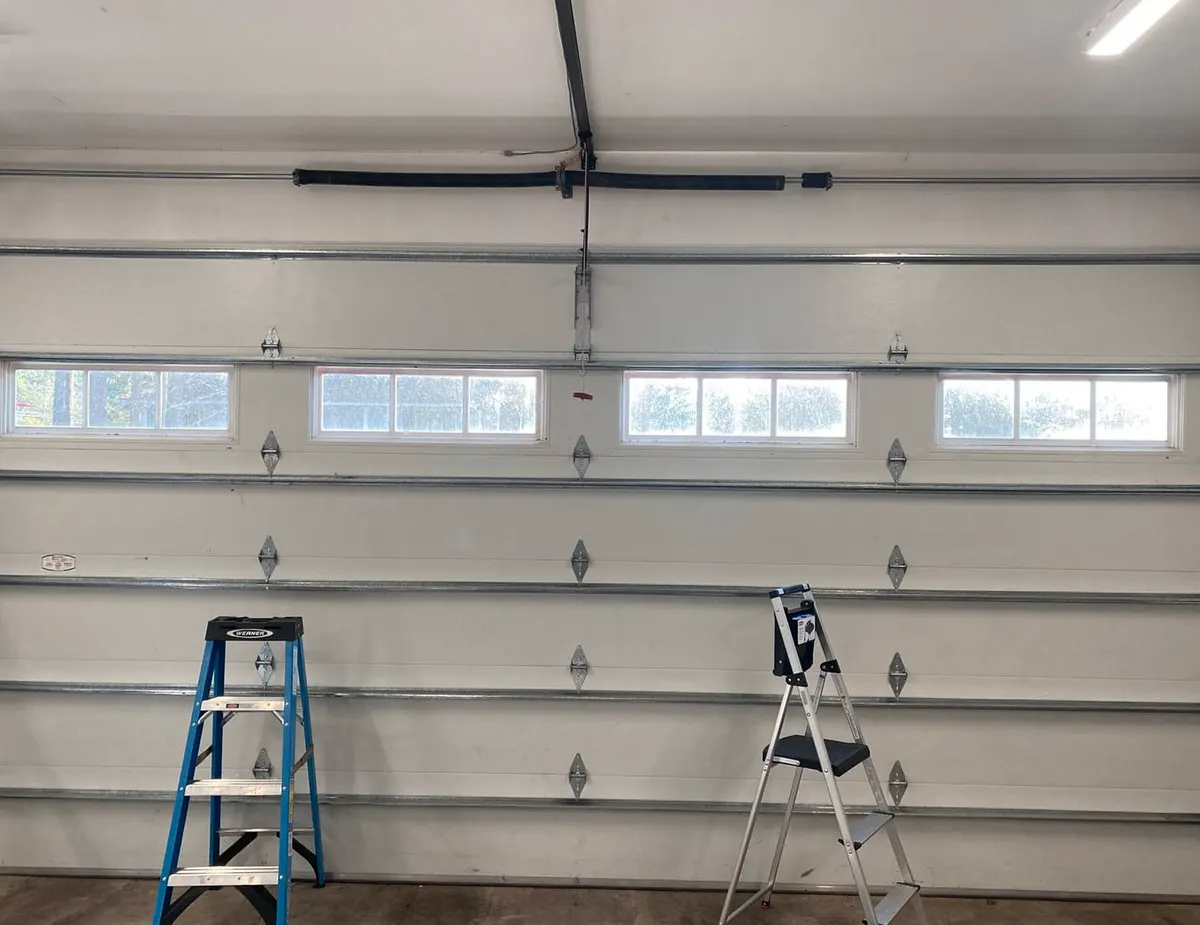
- Find the manual release cord — the red handle hanging from the trolley on the opener rail. Pull it down and toward the back of the garage to disengage the opener from the door.
- Lift the door by hand, slowly, to about waist height (roughly 3 to 4 feet). Pay attention to how much effort it takes. A balanced door lifts with light, even resistance — not a dead weight, not a door that wants to leap out of your hands.
- Let go. A balanced door stays put. Count to ten. If it creeps down even a few inches, or starts to rise on its own, the springs are no longer carrying their share of the load.
- Repeat the test at half open and at three-quarters open. Spring behavior can be uneven along the travel path, especially on older extension-spring setups, so one height passing doesn't mean the whole door is balanced.
- Watch the cables and pulleys while you do this. Fraying, slack, or a cable that's jumped its track is a separate problem from spring tension, but it shows up during the same test.
- Reconnect the opener by pulling the release handle again (or following your opener's reconnect procedure) once you're done, and run the door through a full cycle to make sure the trolley re-engaged properly.
- Write down what you saw — where it held, where it drifted, how much force it took to lift. That record is exactly what a technician needs to diagnose the problem fast instead of re-running your test from scratch.
What an unbalanced door does to the opener
The opener's motor is built to move a door that's already doing most of the work itself, courtesy of properly tensioned springs. When a door is unbalanced, the opener has to make up the difference every single cycle — pulling a heavier-than-designed load on the way up, or fighting a door that wants to slam down on the way down. That shows up over time as a motor that runs hot, a gear that strips early, drive belts or chains that stretch and skip, and circuit boards that take more electrical strain than they're rated for. Some owners respond by cranking up the force setting to compensate, which only masks the symptom while accelerating wear on everything downstream — the opener keeps working harder, not smarter. A balance problem left alone for a season or two often turns a $150–$300 spring job into a $400–$600 spring-plus-opener repair.
This matters more here than in milder climates. Freeze-thaw cycles through a Philadelphia winter put metal springs through repeated expansion and contraction, and road salt tracked into the garage accelerates corrosion on coils and cables. Decades-old torsion springs in the area's older housing stock were often sized for a door that's since been reskinned, insulated, or replaced with a heavier model — another common source of imbalance that has nothing to do with age alone.
Where the line is: homeowner vs. technician
Running the balance test, watching for drift, and reconnecting the opener afterward are all safe, reasonable homeowner tasks. Adjusting the problem is not. Torsion springs store enormous energy under tension, and retensioning them requires winding bars, a ladder set at the right height, and the training to know how many quarter-turns a given spring needs — guessing here has put people in the ER. Extension springs carry similar risk if the safety cables aren't rigged correctly. If your test shows drift, binding, or uneven resistance, the fix belongs to a technician, not a second trip to the hardware store.
When to call Philadelphia Garage Door
If your door fails the balance test, or you're not sure what you're looking at, that's exactly what our Garage Door Maintenance & Tune-Up visits are for — we'll run a full balance and cable inspection, check opener force settings against actual door weight, and tell you plainly whether you need an adjustment or a full Spring Replacement. Catching an imbalance before deep winter means fewer emergency calls when a cold snap finally pushes a weak spring past its limit.
If you're anywhere from Northeast Philadelphia to Bensalem, Cheltenham, Jenkintown, Elkins Park, Abington, Willow Grove, or Levittown, call Philadelphia Garage Door and we'll get a technician out to check your balance before winter does it for you.